Why Truck Crashes Are More Dangerous Than Car Crashes
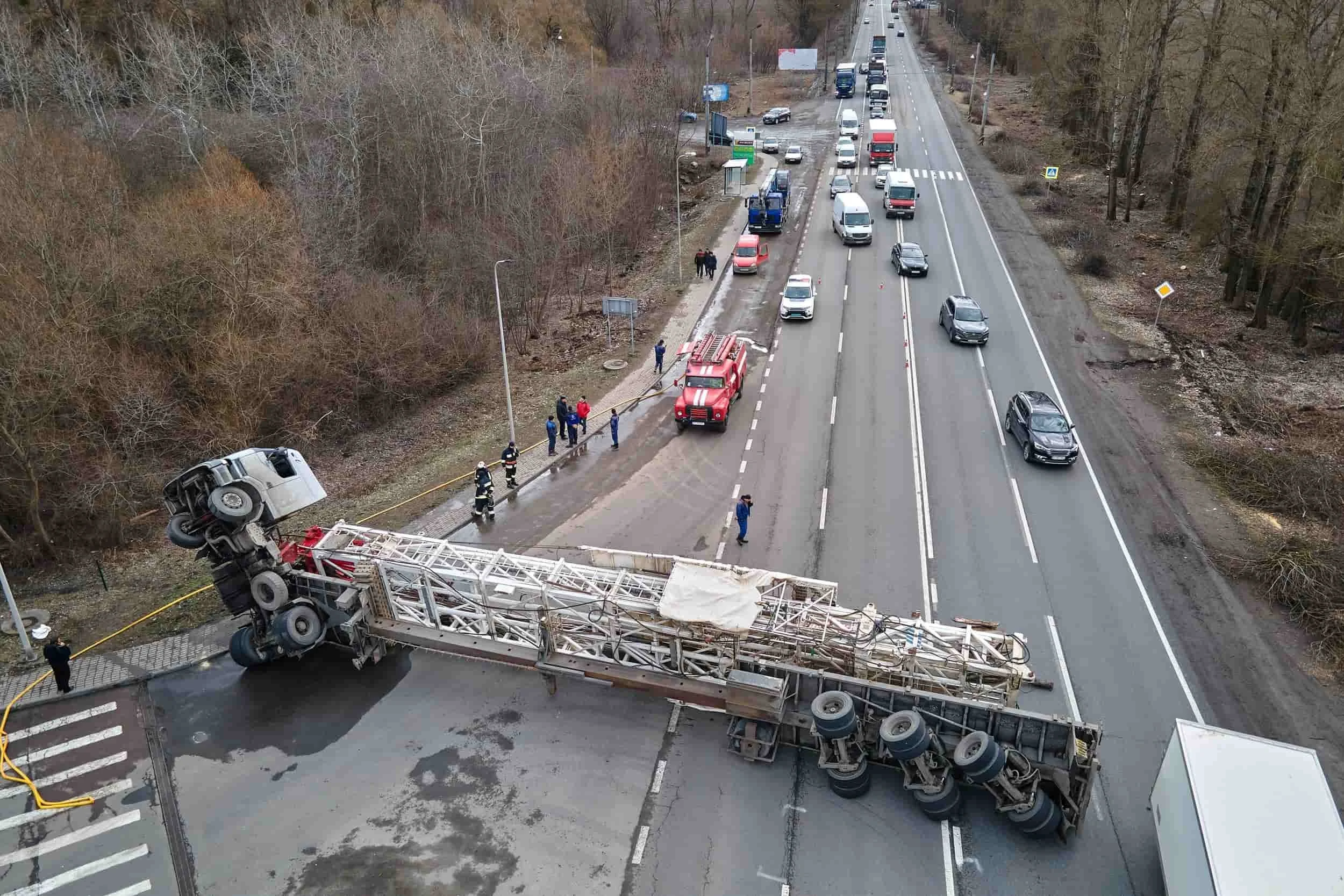
You see them on the highway. Tall, heavy, moving fast. A semi-truck. A logging truck. A dump truck. Forty tons of steel and cargo rolling past your car.
When they crash, it is almost always the people in the smaller car who pay the price.
This post walks through why. The weight. The stopping distance. The blind spots. The cargo. The kinds of wrecks that only happen with big rigs. And why truck crashes can so often be so much more devastating to Oregon families than a typical car crash.
Oregon Numbers Tell the Story
The danger is not just in how they look. It shows up in the numbers.
In 2022, Oregon recorded 1,364 truck crashes, in which 968 people were injured, and 71 were killed. (ODOT 2022 Traffic Crash Summary).
Over the five years from 2018 to 2022, Oregon saw more than 10,000 truck crashes — and 295 truck-crash deaths.
Trucks are a small share of the vehicles on the road. But they cause more than their share of tragedy. Learn more on our Oregon Truck Accident page.
The Weight and Force of Big Trucks
A passenger car weighs about two tons. A fully loaded semi-truck can weigh forty.
That weight matters.
When a truck hits a car, the car moves. Metal bends. The people inside are thrown against their belts and doors.
The physics is simple. Kinetic energy grows with the square of speed and rises in lockstep with weight (IIHS, Vehicle Size and Weight). A truck twenty times heavier than a car carries twenty times the energy at the same speed. Even at low speeds, the force is crushing. Even a slow bump from a truck can crumple the back of a car and break bones.
Crash energy has to go somewhere. In a truck-on-car crash, it goes into the car.
Stopping Distance
A car going highway speed can stop in the length of a football field.
A semi needs two.
According to the Federal Motor Carrier Safety Administration, a passenger car at 65 mph needs about 300 feet to stop. A fully loaded semi at the same speed needs about 600 feet.
Wet pavement. A hill. Worn brakes. All of these stretch that distance farther.
Big trucks also use air brakes, not hydraulic brakes. Air brakes have a small lag time before they grab. At highway speed, that lag can mean another 30 or 40 feet.
That is why a truck following too close is so dangerous. It cannot stop in time.
Blind Spots and Rollovers
Trucks do not turn or see like cars.
To make a right turn, a truck swings wide. It crosses into another lane. It cuts across the space where a car may sit at a red light.
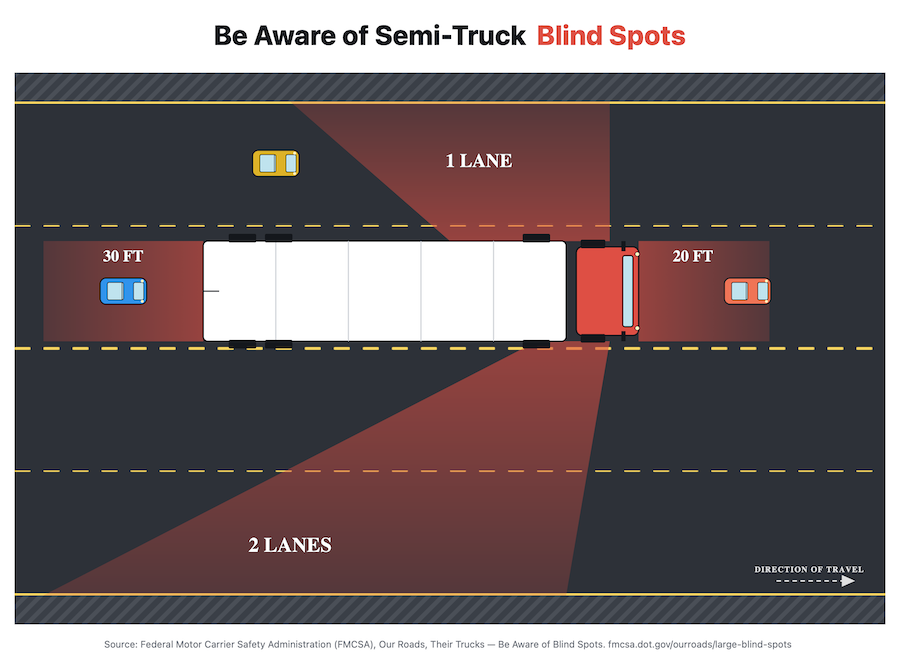
There are blind zones. Beside the cab. Behind the trailer. Even right in front of the truck. If you are there, the driver may not see you at all.
And then there is balance. A truck is tall. Its cargo shifts. On a sharp curve, it can tip and roll.
Roads through the Gorge. The curves of I-5. The Coast Range. These are places where a truck can lose its grip.
Shifting Cargo Creates Hazards
A truck carries more than steel and rubber.
Logs. Gravel. Fuel. Chemicals.
If the load shifts, the truck may sway or fall. If the load spills, the road becomes a trap for everyone behind.
Logging trucks are a special risk in Oregon. A chain snaps. A log rolls loose. The results are often deadly.
See our Oregon Logging Truck Accident page.
Aggressive Truck Driving Magnifies the Danger
Most truck drivers are careful. But not all.
Tailgating. Speeding. Cutting into lanes without space. Driving too long without rest.
Any of these is bad in a car. In a truck, they can be fatal.
This includes delivery trucks racing through Portland traffic to meet tight delivery windows. See our Portland Delivery Truck Accident pageand our blog post on Aggressive Truck Driving.
Driver Fatigue and Poor Maintenance
There are two more reasons truck crashes are so dangerous, and they happen behind the scenes.
The first is fatigue. Federal rules limit how long a trucker can drive in a day. Those rules are not always followed. A tired driver reacts more slowly. In a forty-ton vehicle, a slow reaction is a catastrophe.
The second is maintenance. Brakes wear. Tires wear. Trailers wear. Trucks rack up hundreds of thousands of miles. When a company skips inspections to save money, a small failure becomes a big one at highway speed.
Fatigue and maintenance are at the heart of many truck cases. We discuss both in detail on our Truck Accident pageand on our Portland Semi-Truck Accident page.
Deadly Crashes Unique to Big Rigs
Some wrecks happen only with trucks. They are violent, sudden, and often deadly.
Jackknife Crashes
A jackknife happens when the trailer swings out at an angle to the cab, forming an "L" or "V" shape. In seconds, the truck blocks multiple lanes. Cars behind may have nowhere to go.
These crashes often happen when a driver brakes hard on wet or icy roads, or when the trailer load shifts. Once the trailer swings wide, the truck becomes nearly impossible to control. Pileups and chain-reaction crashes are common. (FMCSA Safety Overview).
Underride Collisions
An underride happens when a car slides under the back or side of a truck. The truck's clearance is high. The car's hood and roof take the impact instead of the bumper or airbags. The passenger compartment can be crushed in an instant.
These wrecks are often fatal. They happen most often at night, when drivers cannot see a slow-moving or stopped trailer until it is too late.(NHTSA Underride Study, PDF).
Tire Blowouts
A semi-truck tire is massive. When it bursts at highway speed, the explosion is loud and violent. The truck may lurch into another lane or tip toward a car beside it.
Shredded tire debris — known as "gators" — flies across the road, striking windshields or leaving sharp rubber and steel in the path of other drivers. Blowouts often lead to rollovers or loss of control, especially if the truck is fully loaded.
These are not fender-benders. They are catastrophic events that close highways, injure dozens, and can change people’s lives forever.
Life-Changing Injuries From Truck Collisions
Truck crashes often bring the worst injuries:
Brain injuries. See our Brain Injury page for more information on the devastating, life-changing effects of brain injuries.
Spinal cord damage and paralysis
Crushed bones and amputations
Internal bleeding and organ damage
Wrongful death. See our Wrongful Death pagefor more information on those tragic claims.
Oregon's Tragic Truck Wrecks
In May 2023, a semi-truck driver veered off I-5 north of Albany and slammed into a parked van carrying eleven farmworkers. Seven people died. Three more were seriously hurt.
The driver was later convicted of seven counts of second-degree manslaughter and sentenced to more than 48 years in prison. He had cocaine, methamphetamine, and fentanyl in his system at the time of the crash. (OPB).
The Terwilliger Curves on I-5 in Portland are notorious for truck crashes. Five times in just over a mile, the curves change from gentle to sharp. ODOT engineers have called this stretch one of the most accident-prone sections of freeway in the state. Jackknifes and rollovers happen there year after year. (Wikipedia).
Why Truck Accident Cases Are Different From Car Cases
A truck crash is not just a bigger car wreck. It is a different kind of legal case.
In a regular auto crash, you are usually dealing with one driver and one insurance company.
In a truck crash, you may be dealing with several. The driver. The trucking company. The company that loaded the cargo. The company that maintained the truck. Sometimes the broker who arranged the shipment. Each one has lawyers. Each one has insurance.
Truck cases are also governed by federal regulations. The Federal Motor Carrier Safety Administration sets rules on hours of service, vehicle inspection, driver qualification, and cargo securement. Violations of these rules can be a key part of proving a case.
And the evidence disappears fast. Trucks have electronic logging devices and onboard data recorders that capture speed, braking, and hours driven. Trucking companies are not always quick to preserve that data unless they are required to.
This is why a truck crash victim needs an attorney who knows the trucking industry — not just one who handles car wrecks.
Why Drivers Should Be Wary
You feel it when you drive near a semi. The size. The noise. The weight.
You are right to be wary. Trucks are harder to stop. Harder to steer. Harder to see around.
And when they crash, it is families in smaller cars who are hurt most.
Why Choose Us After a Truck Crash in Oregon
A truck crash can change everything. Medical bills rise. Work stops. Families struggle.
You need more than sympathy. You need someone who knows the law, the insurance companies, and the tactics they use.
At Grandy Injury Law, we have more than 30 years of legal experience. We focus on serious injury and wrongful death cases — including semi-truck crashes, logging truck accidents, and delivery truck wrecks. And we know how to hold trucking companies accountable. We have recovered millions of dollars for injured clients and grieving families.
We work on a contingency fee. That means no attorney fee unless we win your case.
We also speak Spanish and represent clients throughout Portland, Beaverton, Hillsboro, and across Oregon.
If you or a loved one has been injured in a crash with a semi-truck, logging truck, delivery truck, or other large vehicle in Oregon, call Grandy Injury Law at 503-626-6221for a free consultation. We fight for victims and families after catastrophic truck accidents.
Last Updated: 05-02-2026